
Corporate data centres were built for a different world
Many corporate server rooms were set up at a time when computing requirements were considerably simpler. All that was needed was space for a few servers, network equipment, storage and a backup power supply. Operations were relatively stable, and demands on cooling and power consumption grew more slowly.
Today’s reality is different. Companies are utilising data analytics, integration platforms, continuous data processing, virtualisation, more demanding databases and, increasingly, projects involving on-premises artificial intelligence. All of this is changing the requirements for power consumption, cooling, operational resilience and physical security.
A server room that has historically been sufficient for Enterprise Resource Planning (ERP) systems, email and shared folders may therefore become a bottleneck before the problem becomes apparent.
The problem often only becomes apparent as the child grows
An in-house server room doesn’t usually start to fail overnight. More often than not, it gradually begins to fall behind. The amount of equipment increases, energy consumption rises, temperatures climb, reliance on availability grows, and the in-house team has to deal with an ever-increasing number of operational details.
The tell-tale signs are straightforward: new servers require more power than the installation can accommodate; the cooling system is already stretched to its limits during normal operation; there is no redundant power supply or cooling; maintenance carries a risk of downtime; and access to the room is not controlled in the same way as access to key corporate technology.
At this stage, it is no longer simply a question of whether a more powerful server can be purchased. The question is whether the environment surrounding it is capable of supporting long-term operation.
Availability doesn’t start with documentation, but with power supply and cooling
A Service Level Agreement (SLA) is important, but it does not in itself ensure availability. If the entire server room is dependent on a single power supply route, a single technical room or a single cooling method, its actual resilience is limited.
A professional data centre builds availability right down to the level of the physical infrastructure. Key factors include independent power supply circuits, backup power sources, cooling systems designed for continuous operation, and the ability to carry out maintenance without the need for planned downtime. Only on this foundation does it make sense to build processes, Service Level Agreements (SLAs) and operational accountability.
SafeDX Server Hotel operates using a redundant infrastructure and an environment designed for high availability. The specific operational framework for deploying its own technology is described by the service DataCenterDX.
In more demanding installations, it is also important to note that racks may have a significantly higher power consumption than is usual in corporate server rooms.
Collocation is not a step backwards
Companies sometimes view the migration of infrastructure to a data centre as a complication. In reality, the opposite may well be true. The company retains control over its own hardware, but it runs in an environment specifically designed for its operation.
Server colocation makes particular sense for systems that are stable over the long term, have predictable requirements, and which the company is unwilling or unable to move to the public cloud. The data centre provides space, power, cooling, connectivity, security and operational monitoring. At SafeDX, this need is met by the service RackHousingDX.
The network layer is also important. Moving to a professional data centre can make it easier for a company to access redundant connections, dedicated connectivity or direct links to operators, without having to manage everything in its own server room. These options are covered by the service ConnectivityDX.
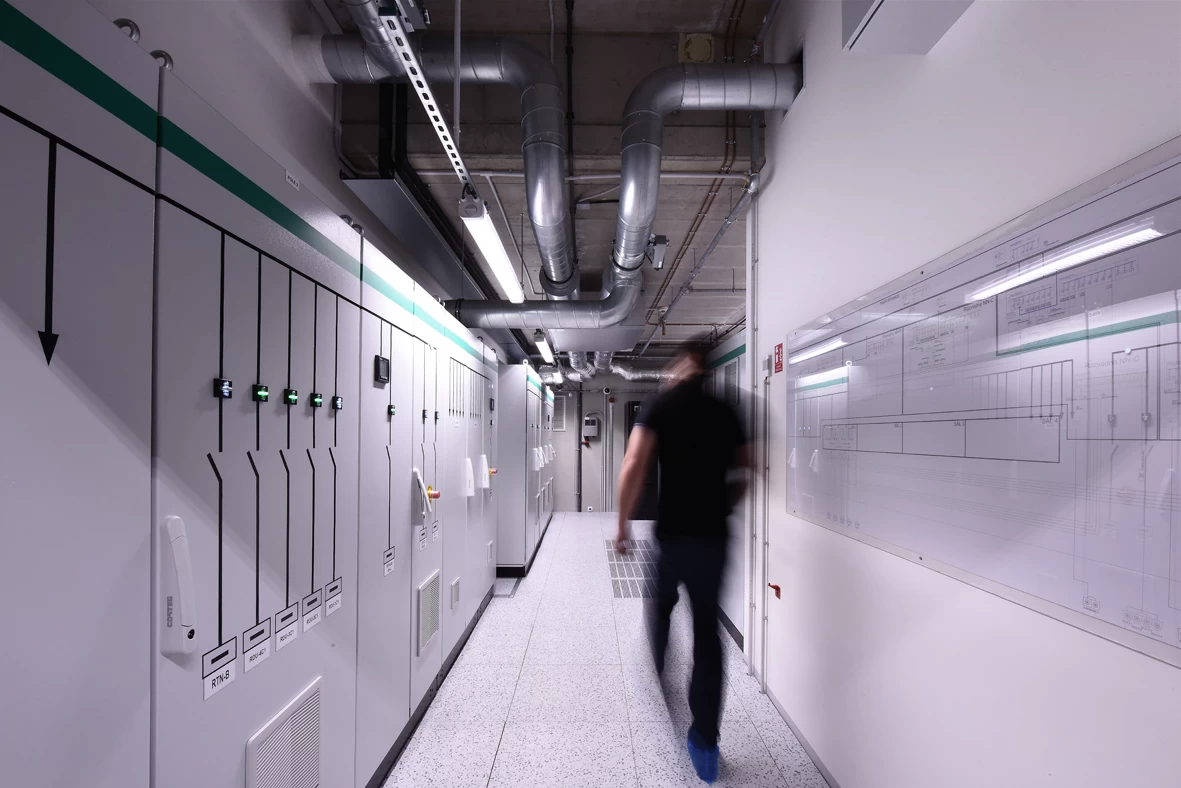
Are you wondering whether your server room is still up to the job?
SafeDX will help you assess whether your current server room still meets your company’s requirements, or whether it would make sense to move to a server hotel, rack housing or server colocation in a professional data centre.
To get a general idea, have a look at Introduction to the SafeDX data centre. If you are already planning a specific location for your own infrastructure, the RackHousingDX service ties in with this, with a form available directly on the service’s webpage.